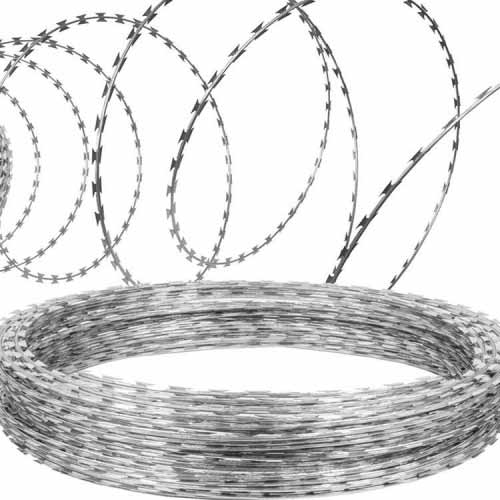
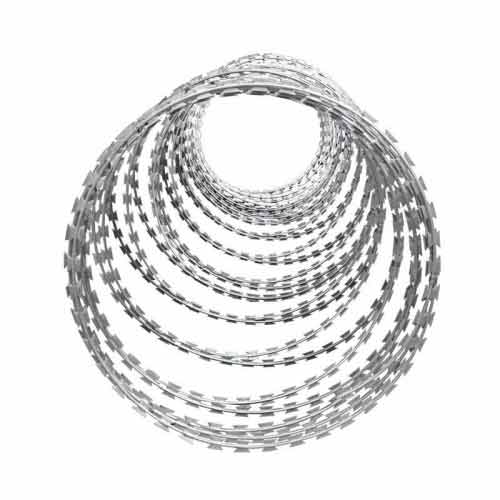
Product details description
Razor wire, distinct from barbed wire due to its razor-sharp blades and
scissor-like profile, is a high-security perimeter solution used in military
bases, maximum-security prisons, and critical infrastructure. Installation is a
hazardous and highly technical process governed by strict safety protocols and
engineering standards. The primary requirement is the use of specialized
hardware: "R-clips" or "clamp bars" made of high-strength steel to secure the
wire to the posts without crushing the coils. Standard staples or wire ties are
insufficient as they cannot withstand the tension or the cutting action of the
wire if it shifts.
The tensioning of razor wire is critical to its function. Unlike standard
fencing, razor wire is installed under high tension (often 300-500 lbs) to
ensure the coils remain rigid and the blades project outward. If the wire is too
loose, it hangs vertically, allowing an intruder to climb over the loops. If it
is too tight, the metal fatigue can cause the wire to snap, creating a dangerous
projectile. Tensioning tools, such as ratchet come-alongs or wire stretchers,
must be used in sequence, starting from the end post and working toward the
intermediate posts. The wire is typically installed in a "concertina" or
"spiral" pattern, overlapping by at least 300mm to prevent gaps.
Post spacing and depth are dictated by the need to resist impact. For razor
wire, posts (usually steel H-posts or heavy-duty wood) must be spaced no more
than 8 to 10 feet apart to prevent sagging under the weight of the heavy coils.
The depth of the hole depends on the soil type and the height of the fence; for
a 6-foot fence, a hole depth of 3 to 4 feet is standard, filled with concrete to
create a rigid foundation. In sandy or loose soil, deeper holes or auger-cast
piles are required. The posts must be plumb (perfectly vertical) because any
angle allows the wire coils to slide downward, creating a security vulnerability
at the top.
Safety during installation is paramount. Installers must wear full-body
harnesses when working at heights and heavy-duty cut-resistant gloves (often
Kevlar or leather) at all times, as the blades can cause severe lacerations
instantly. A "no-go" zone must be established around the work area to prevent
unauthorized personnel from entering. The wire is unspooled using a "spinner" or
a rotating drum to prevent it from kinking, which weakens the structure. Never
unspool razor wire by hand, as the sudden release of tension can cause the coil
to whip around violently.
Legal restrictions on razor wire are more stringent than for other fencing
types. In many civilian jurisdictions, it is illegal to use on residential
properties due to the risk of lethal injury. Even in commercial settings,
warning signs must be posted at regular intervals (e.g., every 50 feet). The top
of the fence often requires a "finial" or anti-climb bracket to prevent tools
from being used to leverage the wire down. Proper grounding is also a
consideration if the fence is electrified, though razor wire is often used
passively. Adherence to local building codes and OSHA regulations is mandatory
to avoid liability for installation accidents or entrapment injuries.
Previous article:
Selecting the Right Razor Wire for Your Specific Security Needs
Next article:
Razor Wire Environmental Considerations: Weather Resistance and Long-Term Performance