Product details description
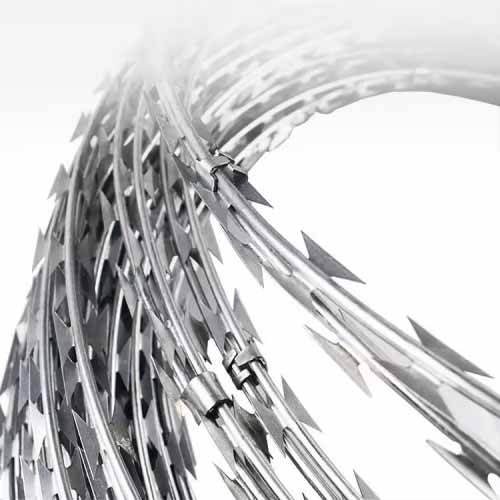
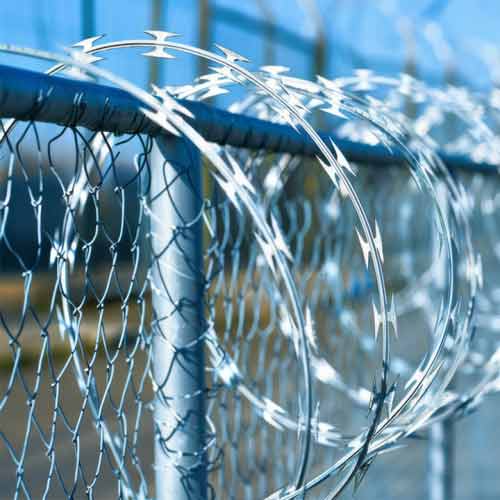
Razor wire and concertina coil barriers provide high-security perimeter
protection for correctional facilities, military installations, industrial
properties, and other applications requiring deterrent and delay capabilities
against forced intrusion. The environmental exposure these installations face
over their service lives creates durability requirements that must be addressed
through appropriate material selection, installation practices, and ongoing
maintenance programs. Understanding how razor wire performs under various
environmental conditions enables facility managers, security professionals, and
specifiers to make informed decisions about product selection, installation
methods, and lifecycle management that optimize security effectiveness while
managing long-term costs. The harsh environment resistance of quality razor wire
products represents a critical factor in their lifecycle cost calculations.
Corrosion resistance represents the primary environmental consideration for
razor wire installations, as the sharp blade characteristics that define razor
wire effectiveness depend on edge geometry that can be compromised by rust and
corrosion development. Quality razor wire products utilize heavy galvanization
or stainless steel construction to provide the corrosion resistance necessary
for extended outdoor service, with coating weights specified according to
anticipated exposure conditions and required service life. Hot-dip galvanization
with coating weights exceeding 350 grams per square meter provides excellent
protection for most applications, while marine-grade or stainless steel products
serve coastal environments where salt spray creates accelerated corrosion
conditions. Installation practices should minimize coating damage at cut ends,
connection points, and attachment locations, with protective treatments applied
to any areas where galvanization has been compromised during installation.
Temperature resistance and thermal cycling performance affect razor wire
installations in extreme climate regions, where the temperature variations
between seasonal extremes can create stresses in materials and connections.
Quality razor wire maintains its mechanical properties and dimensional stability
across temperature ranges from -40°F to 160°F (-40°C to 71°C) typical of global
deployment conditions, with testing confirming retention of blade sharpness,
wire strength, and connection integrity through thousands of thermal cycles. The
high-carbon steels used for blade components provide the hardness necessary for
sharp edge retention but must be properly alloyed and heat-treated to maintain
these properties across temperature extremes. Connection systems and attachment
hardware should similarly meet temperature resistance specifications appropriate
for deployment locations, with materials selected to avoid the differential
expansion issues that could create stresses or gaps in barrier systems.
UV radiation exposure affects the polymer coatings and packaging materials
used in some razor wire products, potentially leading to embrittlement, color
fade, or degradation of protective coverings over extended service life. Quality
products incorporate UV stabilizers in any polymer components, with testing
confirming retention of physical properties through accelerated UV exposure
equivalent to 10 to 15 years of outdoor service. Metal components including
wires and blades are inherently resistant to UV effects, with coating systems
designed to maintain protective effectiveness regardless of sun exposure levels.
Installation planning should consider sun exposure patterns, with south-facing
installations in northern hemisphere locations receiving more intense UV
exposure than north-facing installations, potentially affecting the longevity of
UV-sensitive components. Regular inspection of razor wire installations should
include assessment of any polymer components for signs of UV degradation, with
replacement of degraded components before they fail to maintain barrier
effectiveness.
Previous article:
The Installation Requirements for Razor Wire Fences
Next article:
Flat Wrap Razor Wire - Flexible Deployment for Any Surface