Product details description
Razor wire, a high-security fencing material characterized by its sharp,
blade-like edges, is available in several distinct types—each with unique
specifications and design features tailored to specific security needs. From
permanent perimeter protection of critical infrastructure to temporary crowd
control at large events, the choice of razor wire type depends on factors such
as threat level, installation environment, and mobility requirements. Flat wrap,
concertina, and mobile barrier designs are the most common variants, each
offering different advantages in terms of deterrence, ease of installation, and
adaptability. Understanding the specifications and ideal use cases of each type
is essential for security professionals tasked with designing effective
protection systems.
Flat wrap razor wire, also known as flat razor tape, is a versatile type
characterized by its thin, flat design, where sharp blades are punched or cut
into a galvanized or stainless steel strip. Its key specifications include blade
thickness (typically 0.5 to 1.0 mm), blade spacing (5 to 15 mm), and strip width
(25 to 50 mm). The flat profile allows for easy installation on existing fences,
walls, or gates, making it an ideal choice for retrofitting security systems. It
is often used to enhance the security of residential fences, commercial property
perimeters, and low-to-medium threat industrial sites. Flat wrap razor wire can
be installed horizontally along the top of fences or vertically along the sides,
creating a barrier that deters climbing and cutting. Its thin design makes it
less visually obtrusive than other types, while still providing effective
deterrence.
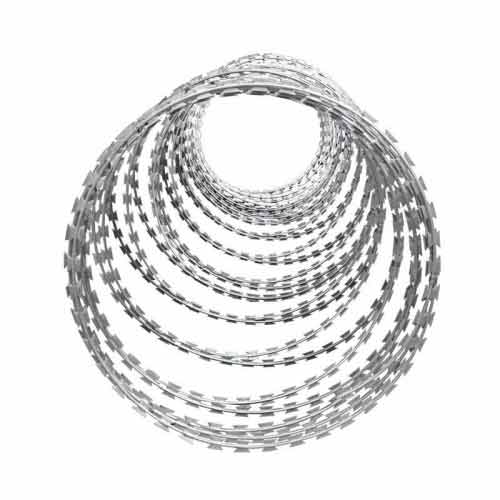
Concertina razor wire, named for its coiled, accordion-like shape, is
designed for high-security applications requiring a dense, impenetrable barrier.
Its specifications include coil diameter (ranging from 450 to 1200 mm), wire
gauge (1.2 to 2.0 mm), and blade type (standard or high-tensile). The coiled
design allows for quick deployment, as the wire can be expanded to form a
cylindrical barrier or stretched into a linear fence. Concertina razor wire is
commonly used for perimeter protection of critical infrastructure, such as power
plants, airports, and military facilities, as well as for border security. It is
often installed atop concrete walls or chain link fences, creating a barrier
that is extremely difficult to climb or breach. Galvanized or PVC-coated
variants are available to enhance corrosion resistance in harsh environments,
such as coastal areas or industrial zones.
Mobile barrier razor wire designs are engineered for temporary security
applications that require rapid deployment and relocation. These systems
typically consist of concertina razor wire mounted on wheeled frames or
collapsible structures, with specifications including frame material (steel or
aluminum), wheel size, and wire coil capacity. Mobile barriers are ideal for
crowd control at large events, such as concerts or sports games, and for
securing temporary construction sites or disaster response areas. Their key
advantage is mobility—they can be easily transported to different locations and
set up in minutes without the need for permanent installation. Some mobile
designs also feature interlocking mechanisms, allowing multiple barriers to be
connected to form a continuous security perimeter. Additionally, they can be
equipped with reflective strips or warning signs to enhance visibility and
deterrence.
When selecting a razor wire type, it is critical to match the
specifications to the intended application and threat level. For low-threat
environments, flat wrap razor wire with smaller blades and wider spacing may be
sufficient, while high-threat areas require concertina wire with larger coils
and sharper, closer-spaced blades. Mobile barriers are the optimal choice for
temporary security needs, offering flexibility and quick deployment. Regardless
of the type, all razor wire must comply with relevant safety standards to ensure
that it does not pose unnecessary risks to innocent bystanders. Proper
installation, including secure anchoring and clear warning signage, further
enhances the effectiveness and safety of razor wire security systems. By
selecting the right type and specifications, security professionals can design a
protection system that effectively deters intrusions while meeting the unique
requirements of the site.
Previous article:
Critical Infrastructure Protection: Razor Wire Applications for Power Plants and Airports
Next article:no more